

For World Blood Donor Day, the Polotsk Zonal State Archives presents documents about the Polotsk Regional Blood Transfusion Station
The word «donor» comes from the Latin «donare», meaning «to give». The help of blood donors is invaluable – the gift to the recipient is often life. The blood of one donor can save three lives. Safe blood and its components are essential for the treatment of most diseases, complex surgeries, and emergency medical care, saving lives every day.
June 14, 1868, marked the birth of Karl Landsteiner, an Austrian physician and immunologist who received the Nobel Prize in 1930 for his discovery of human blood groups. This holiday is in his honor.
On this day, we express our sincere gratitude to people who donate their blood and its components, which are essential for saving human lives, and aim to draw attention to the need for regular voluntary blood donation. The National Blood Service fully supplies healthcare organizations in the Republic of Belarus with high-quality and safe blood components, diagnostic kits of its own production, and essential pharmaceuticals made from human blood plasma.
In 1923, the first blood transfusion in Belarus was performed at the 2nd Soviet Hospital in Minsk. It was performed by M.N.Shapiro (1884-1970), an assistant in the Department of Hospital Surgery at the Faculty of Medicine of the Belarusian State University. Shapiro later became a professor and director of the Minsk Medical Institute, director of the Research Institute of Orthopedics and Reconstructive Surgery, and chief surgeon of the Ministry of Health of the BSSR.
In 1932, Rubashov published the first Belarusian-language brochure on blood transfusion in Belarus. In the section «Donors», the author summarized literary data on blood donation, as well as the seven donors he recruited in 1931. In 1932, four branches of the VF TsIPK were established in the republic: in Vitebsk, Bobruisk, Borisov, and Polotsk.
The Zonal State Archives in Polotsk house documents from the Polotsk Regional Blood Transfusion Station. These documents indicate that the Polotsk Interdistrict Blood Transfusion Station, organized and headed by Dr. M.V.Dunye (1903-1945), operated from 1933 to July 1941. During the occupation of 1941, the station was completely destroyed, along with its archives.
After the liberation of Belarus from the Nazi invaders, the Polotsk Regional Blood Transfusion Station was established on April 1, 1945. Due to the extensive destruction of the city, the station was established within the surgical department of the Lenin Regional Hospital. The station staff had two small rooms at their disposal, one of which served as an operating room for blood collection, and the other as a preoperative, washing, and assembly area. The station operated under these conditions until the completion of the city polyclinic (June 1949). Four small rooms within the polyclinic were allocated for the blood transfusion station.
Until September 1950, the Polotsk Regional Blood Transfusion Station was headed by A.L.Dorosinsky, then by N.S.Lekah.
At the time of this report (1952), there were 190 active donors (donors who had donated blood within the last four months were considered active). From 1945 to 1952, 768 donors passed through the station. In 1951, 12 donors were awarded the «Honorary Donor» badge or a certificate of honor.
Among the employees of the Zonal State Archives in Polotsk there are active donors: Molotok Tatyana Cheslavovna and Safronov Pavel Mikhailovich.
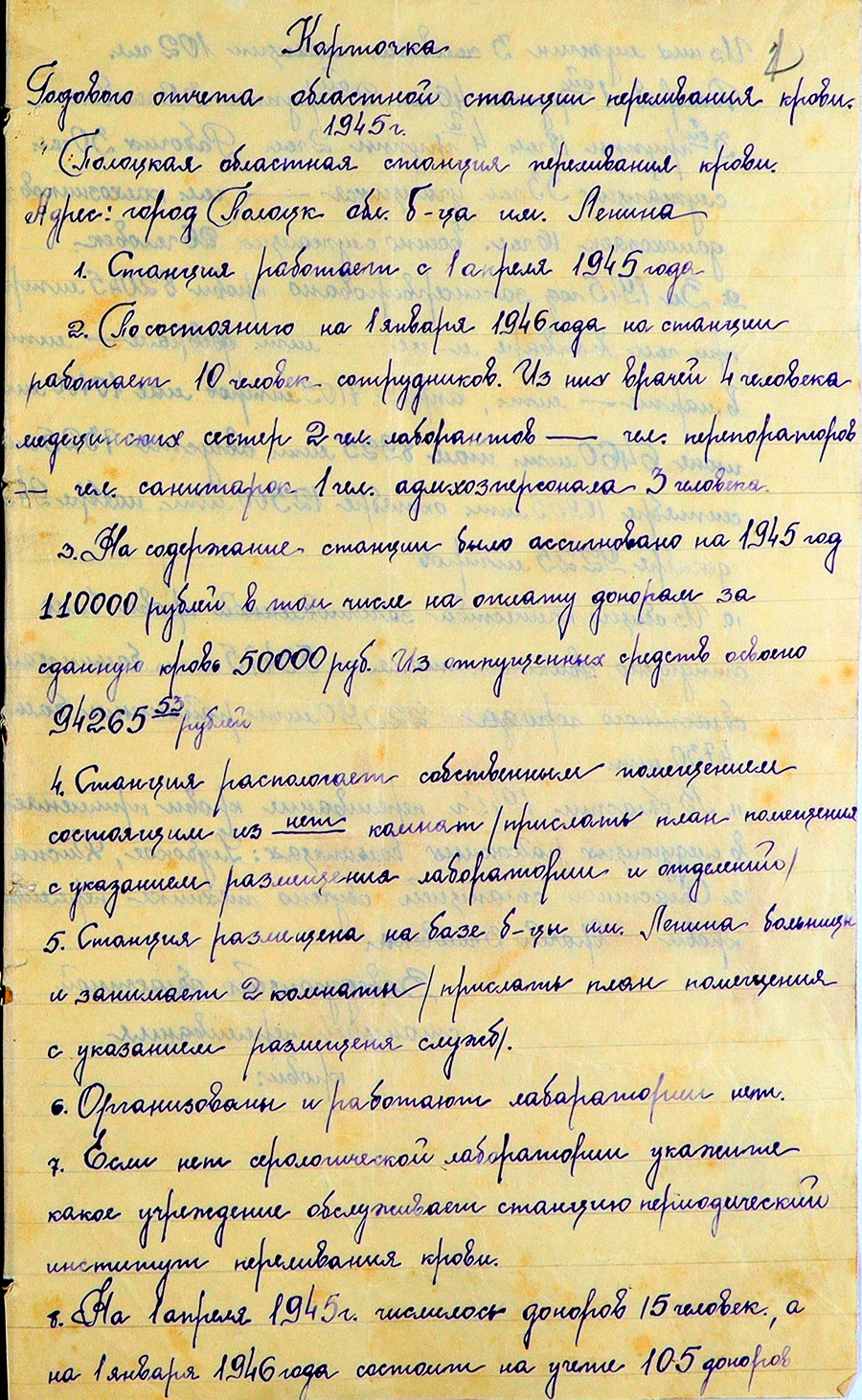 |
| 1. Card of the annual report of the regional blood transfusion station for 1945. ZGAPol F.1067 Op.1 D.2 L.1. |
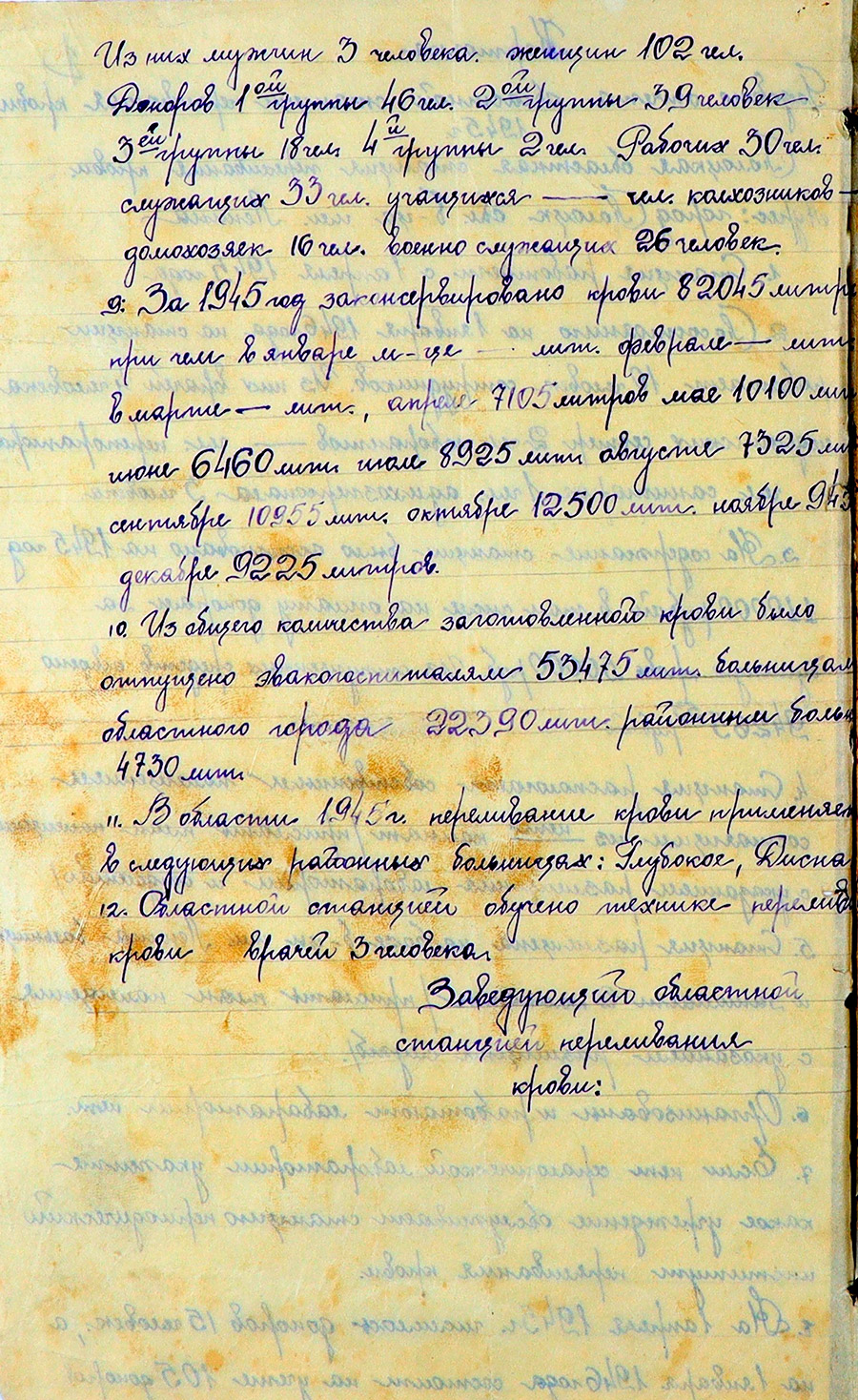 |
| 2. Card of the annual report of the regional blood transfusion station for 1945. ZGAPol F.1067 Op.1 D.2 L.1ob. |
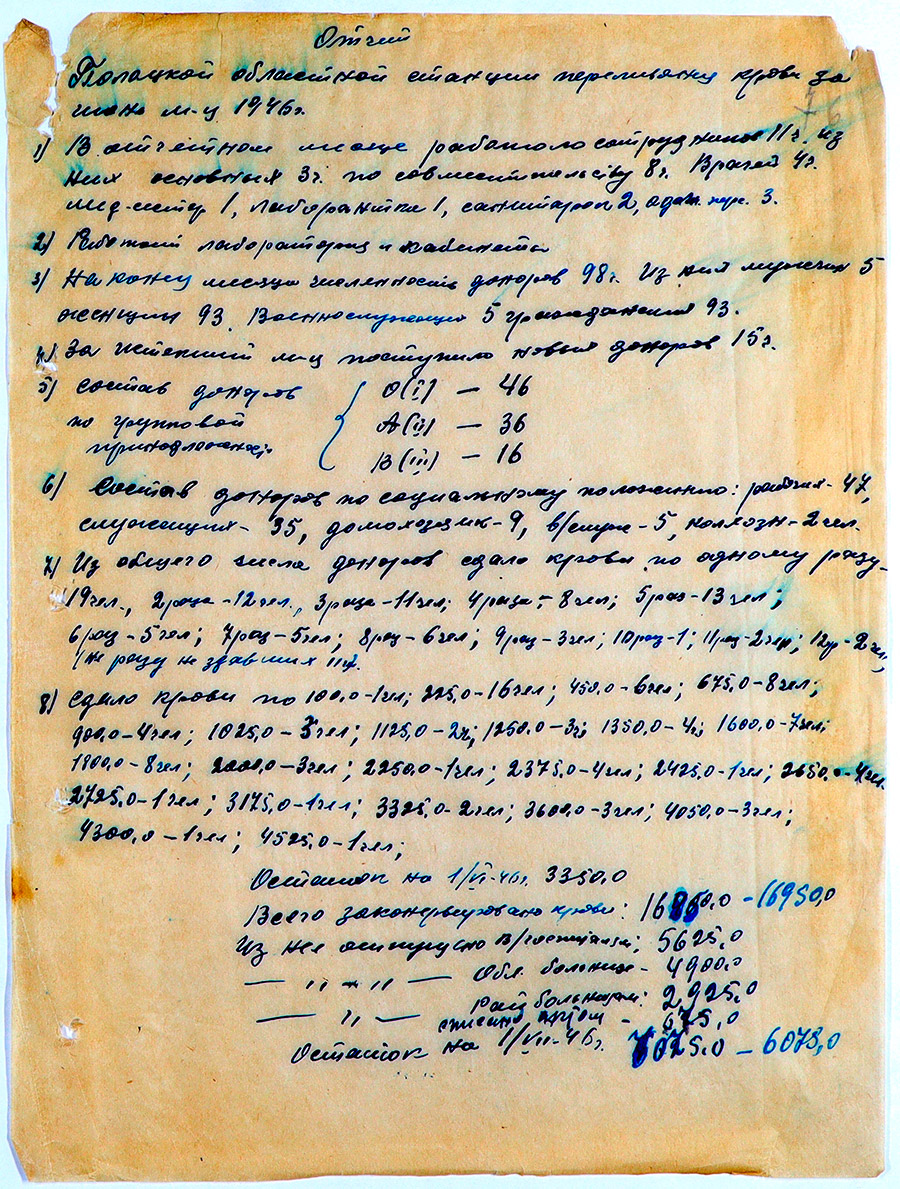 |
| 3. Report of the Polotsk regional blood transfusion station for June 1946. ZGAPol F.1067 Op.1 D.3 L.6. |