

On the Board Meeting of the Department of Archives and Records Management of the Ministry of Justice of the Republic of Belarus
On July 28, 2026, a board meeting of the Department of Archives and Records Management of the Ministry of Justice of the Republic of Belarus (hereinafter referred to as the Department) was held. Deputy Minister of Justice Oleg Nikolaevich Kot participated in the board meeting. Also present were Sergei Vasilievich Gomon, First Deputy Chairman of the Bellegprom Concern, and Ivan Viktorovich Latushkin, Head of the Department for the Protection of State Secrets and Documentation Support of the Ministry of Justice.
The following issues were discussed at the board meeting:
1. On the progress of organizing work to reduce bureaucratic burdens in national government bodies and the implementation by the Department and state archival institutions of Directive No.2 of the President of the Republic of Belarus dated December 27, 2006, «On the Debureaucratization of the State Apparatus and Improving the Quality of Life Support for the Population».
2. On the progress of archival institutions in implementing the «Preservation of Documentary Heritage and Communicating Historical Truth to Society» measure (Clause 59 of the Program of Activities of the Government of the Republic of Belarus for 2025–2029, approved by Resolution No.254 of the Council of Ministers of the Republic of Belarus dated May 8, 2025).
Speaking on the first issue, Deputy Director of the Department, Aleksey Evgenievich Tsvetkov, noted that the Working Group for Conducting a Selective Analysis of Documentation Processes in Republican Government Bodies, established by Order No.38 of the Director of the Department dated August 26, 2025, has conducted significant analytical work in republican government bodies, allowing for an increase in document flow in 2025 compared to 2024. These government bodies received methodological assistance, and practical training was held with both the heads of documentation support services and the heads of the central offices of ministries and departments.
Based on the results of the first half of 2026, the Department conducted a control analysis of the state of document flow in 31 national government bodies and other organizations subordinate to the Government of the Republic of Belarus, compared to the same period in 2025. Based on the comparative analysis and measures taken to optimize office workflows, the overall volume of document flow in national government bodies decreased by 14.74%. This positive trend was influenced by the Methodological Recommendations for Optimizing Document Generation and Document Flow in Government Agencies and Other Organizations, which were communicated to government agencies in August 2025, as well as the Department’s methodological work on the ground.
A positive development was the reduction in the share of internal correspondence in certain government agencies. The meeting proposed a further algorithm for debureaucratizing office work processes in the second half of 2026.
Elena Aleksandrovna Stukanova, Deputy Director of the National Archives of the Republic of Belarus, served as co-presenter on the first item. She presented an analysis of the work of national government bodies with electronic documents. E.A.Stukanova noted that the National Archives will continue to provide ongoing methodological assistance to acquisition sources to increase the share of electronic documents in office work, with an emphasis on preserving the records of the National Archival Fund.
Yulia Vladimirovna Baidanova, Head of the Department for Document Management, Ideological Work, and International Cooperation, presented information on the «Progress of the Implementation by the Department and State Archival Institutions of Directive No.2 of the President of the Republic of Belarus dated December 27, 2006, ‘On the Debureaucratization of the State Apparatus and Improving the Quality of Public Services’« as part of the first item on the board meeting agenda. She noted that the management of archival institutions continuously monitors and analyzes citizen feedback on the effectiveness of their institutions and the state of labor and performance discipline.
As part of the board’s consideration of the second question, reports were presented by A.V.Kochetkova, Deputy Head of the Department of Records Management, Formation, and Preservation of the National Archival Fund, «On the Creation of Digital Copies of Particularly Valuable Documents of the National Archival Fund»; by Yu.V.Baidanova, Head of the Department of Document Use, Ideological Work, and International Cooperation, «On the Creation of Virtual Exhibitions on the History of Belarus Based on Archival Documents on the Internet»; and by co-reports by M.M.Glushakov, Director of the National Historical Archives of Belarus, and L.N.Tsalabanova, Deputy Director of the State Archives of the Mogilev Region.
The Board noted that work with particularly valuable documents (hereinafter, EVD) is the focus of virtually all preservation efforts. In this regard, when developing proposals for the Government of the Republic of Belarus Program of Activities for 2025–2029 (hereinafter, the Government Program), taking into account the fixed volume and separate accounting of EVD, the objective was to focus efforts on creating digital copies of the user collection for this category of documents. Thus, the creation of digital copies of documents from the National Archival Fund (hereinafter, NAF) (at least 45 percent of the NAF’s particularly valuable documents) became the goal and mechanism for implementing Task 59, «Preserving Documentary Heritage and Communicating Historical Truth to Society», of the Government Program of Activities.
To implement this Program, the Minister of Justice approved the Ministry of Justice’s Action Plan for the Implementation of the Government Program (hereinafter, the Action Plan of the Ministry of Justice) and its appendices on May 22, 2025. As a result, documents categorized as «especially valuable» accounted for over 50 percent of the total number of storage units digitized in 2025.
For 2026, this figure has been increased to 81 percent (including film documents – 87 percent) of the total planned target.
Positive momentum is clearly evident in the implementation of the Government Program.
In 2025, 7,650 especially valuable files were digitized, and in the first half of 2026, 8,216 files (64 percent of the annual plan).
As of July 1, 2026, digital copies had been created for 24.6 percent of especially valuable storage units categorized as «especially valuable». To determine the conditions for completing this task, additional calculations were conducted at each state archive, taking into account the achievement of 100 percent digitization of especially valuable files where their volumes allow. By January 1, 2027, 48 percent of archives will have achieved 100 percent digitization. The main solutions to this problem have been identified.
In 2025, scanning equipment was purchased for eight archival institutions. Plans are in place to continue improving the logistical support for the digitization process in 2026: scanners have already been purchased and installed at the National Archives of Belarus (NIAB), the Belarusian State Archives of National Antimonopoly Documentation (BGANTD), and the State Archives of the City of Zhlobin. Scanner deliveries are planned for the National Archives of Belarus (NARB), the National Archives of Belarus (NIAB) in Grodno, the Central Document Preservation Laboratory (NAF), the State Archives of the City of Babruisk, and the State Archives of the Minsk Region. The task of maximizing the use of existing scanning equipment and targeted planning for the acquisition of new equipment remains urgent.
Regarding the work being carried out by state archives to create virtual exhibitions on the history of Belarus, Yulia Baydanova noted that this work is being carried out as part of the Government’s Program for Preserving Documentary Heritage and Communicating Historical Truth to the Public. The quality of the exhibitions being prepared has significantly improved, and they have become an important tool for popularizing the cultural heritage and history of individual regions. At the same time, the quality of project preparation must improve, and joint projects are required, including the development of virtual exhibitions using artificial intelligence technologies.
The Board members deemed the work of state archival institutions on the agenda items satisfactory.
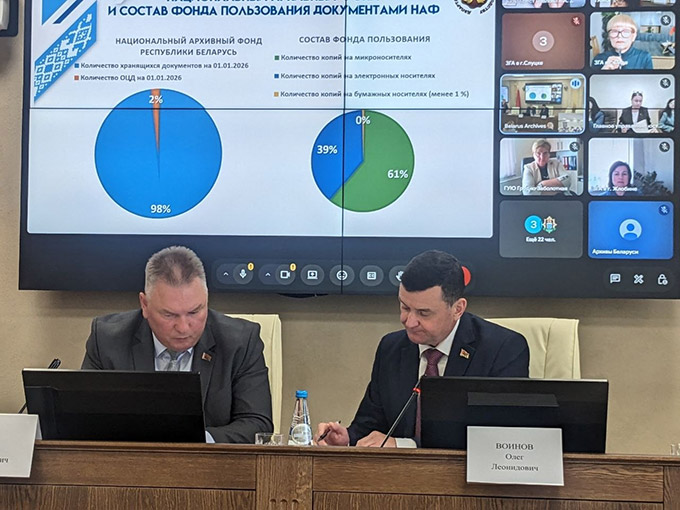 |
| 1. During the Board meeting |
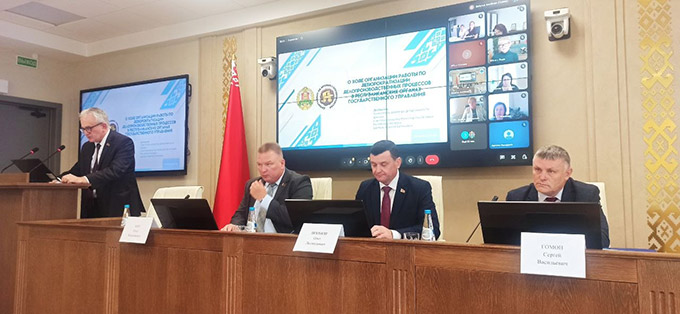 |
| 2. During the speech of Deputy Director of the Department A.E.Tsvetkov |
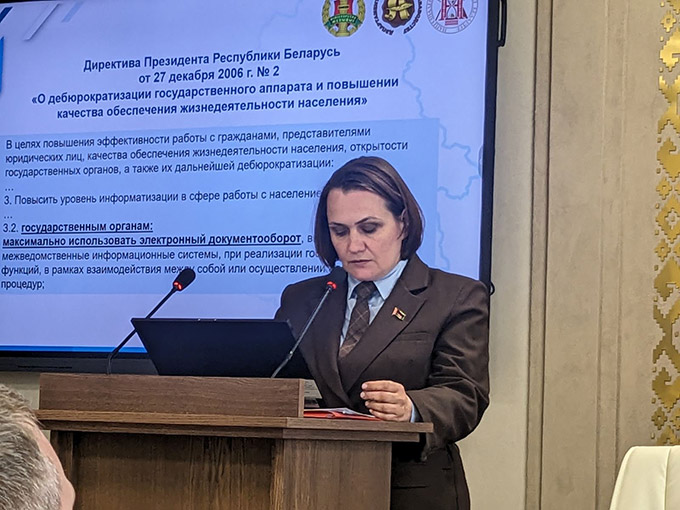 |
| 3. Speaking by E.A.Stukanova |
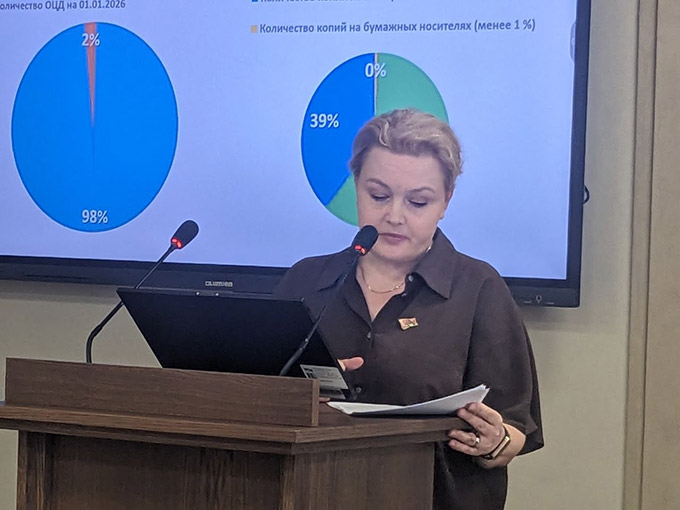 |
| 4. Speaking by A.V.Kochetkova |
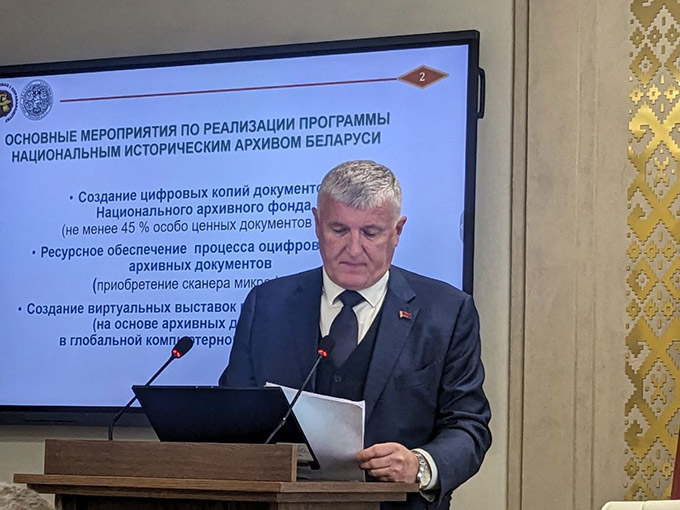 |
| 5. Speaking by M.M.Glushakov |
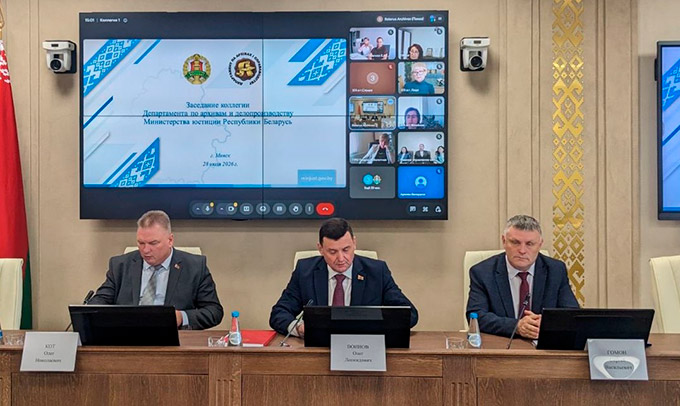 |
| 6. During the Board meeting |