

Oleg Voinov, Director of the Department of Archives and Records Management of the Ministry of Justice of the Republic of Belarus, presented a paper at the Belarusian Legal Forum
The 3rd Belarusian Legal Forum «Law in the Modern World» was held in Minsk on December 4–5, 2025. The forum’s seven platforms addressed legal aspects of social and state development, improvements to the rule-making process, legal education, and the use of artificial intelligence.
Oleg Leonidovich Voinov, Director of the Department of Archives and Records Management of the Ministry of Justice of the Republic of Belarus, participated in the section «Electronic Document Management in Business: Legislation and Law Enforcement Practice». He presented a paper entitled «Practical Issues of Using Electronic Documents in Organizational Activities».
In his paper, the head of the country’s archival industry noted that the country currently has the conditions for organizing work with electronic documents. Issues related to working with these documents, including ensuring their safety and transfer to archival storage, are regulated in regulatory and methodological documents developed by the Department of Archives and Records Management, which fully ensures the organization of work with electronic documents. Particular attention was paid to the need to comply with legal requirements in the field of archival affairs and records management when creating and storing documents in electronic form without paper equivalents.
The section participants were particularly interested in the well-reasoned answers presented in the report, supported by references to legislation, to practical questions regarding the use of electronic documents in documenting employment relationships and in business activities:
– In particular, is it permissible to issue an order regarding disciplinary action and familiarize the employee with it using an electronic digital signature or other equivalent of a handwritten signature? (Answer: An order regarding disciplinary action may be issued as an electronic document, and the employer has the right to familiarize the employee with it using an electronic digital signature or other equivalent of a handwritten signature);
– Is it permissible for employees who do not have an electronic digital signature to familiarize themselves with an electronic document? (Answer: Legislation allows employees to review electronic documents with or without a digital signature (except for concluding, extending, and amending employment contracts and full financial liability agreements);
– Are non-governmental organizations required to send letters via the interdepartmental document management system in PDF/A1 or PDF/A2 format? (Answer: Non-governmental organizations must send letters via the interdepartmental document management system and other information systems, including by email, only in PDF/A1 or PDF/A2 format);
– Are contracts and acceptance certificates for completed work required to be converted to PDF/A1 or PDF/A2 format before signing? (Answer: Contracts and acceptance certificates for completed work sent to third-party organizations as appendices must be converted to PDF/A1 or PDF/A2 format before signing);
– Is it permitted to create internal primary accounting documents electronically without using a digital signature? (Answer: Permitted, provided that the software used in the organization allows for the unambiguous identification of the person who signed (approved, approved) the document; Exception: 1. Documents included in the list of primary accounting documents established by Resolution No.360 of the Council of Ministers of the Republic of Belarus dated March 24, 2011 (consignment note; delivery note; cash receipt order; cash disbursement order; fixed asset acceptance certificate, etc.); 2. Documents confirming the completion of business transactions involving two or more participants, with the exception of primary accounting documents prepared by a single participant in a business transaction in cases established by legislative acts and/or determined by the Ministry of Finance).
Concluding his speech, O.L.Voinov emphasized that with the further digitalization of various spheres of state and public life, the use of electronic documents will become increasingly widespread. In these conditions, it is important not only to closely monitor changes in legislation, but also to ensure the improvement of employee qualifications. The management apparatus of organizations in terms of working with electronic documents and the competent use of the opportunities offered by modern technologies and information systems. This will ensure compliance with legal requirements in the field of archival and records management, as well as in other areas of public relations.
Concluding his presentation, O.L.Voinov emphasized that as various spheres of government and public life continue to digitalize, the use of electronic documents will become increasingly widespread. In this context, it is important not only to closely monitor legislative changes but also to ensure that management staff at organizations are trained in working with electronic documents and are competent in the use of the opportunities offered by modern technologies and information systems. This will ensure compliance with legal requirements in both archival and records management, as well as in other areas of public relations.
Following the conclusion of the section, the discussion of practical issues related to the use of electronic documents in organizations continued behind the scenes. Participants highly appreciated the practical significance of the presentation and thanked the speaker for the relevance and high quality of the information presented.
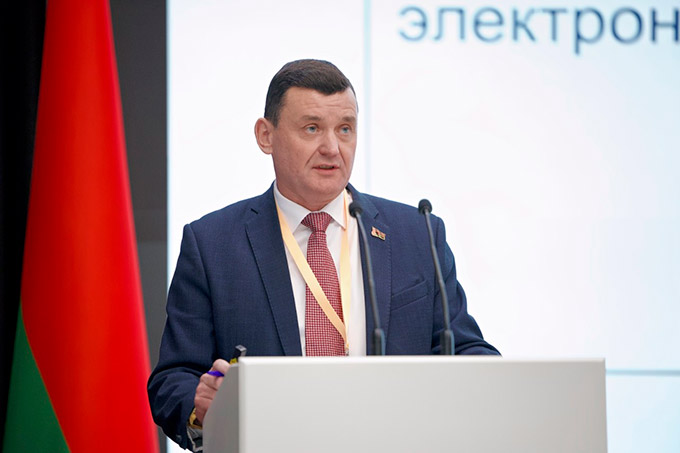 |
| 1. O.L.Voinov, Director of the Department of Archives and Records Management, delivers his presentation. |
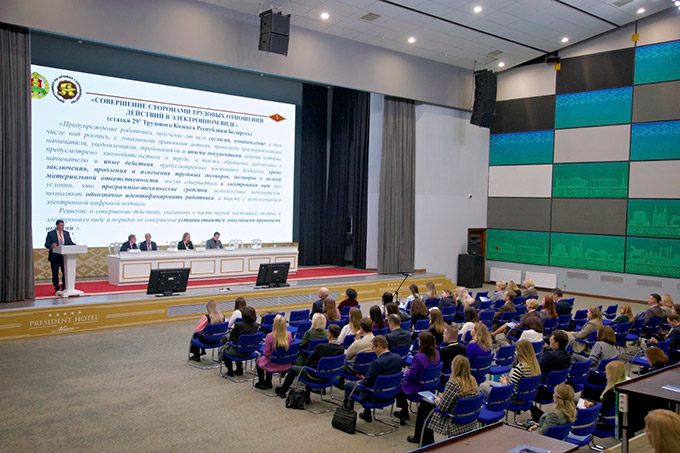 |
| 2. During the section «Electronic Document Management in Business: Legislation and Law Enforcement Practice» |