«From Family Legends to Archival Documents»: Zonal State Archive in Molodechno Hosts Online Meeting for «Zubrenok» National Children’s Center Participants
The Zonal State Archive in Molodechno held an online meeting with young participants from the «Zubrenok» National Children’s Center, focusing on archival research and genealogy. The primary goal was to demonstrate that an archive is not merely a repository for documents, but a place where one can reconstruct their family history.
During the session, the participants learned that before visiting an archive, one must first conduct «home research». This involves interviewing relatives, gathering old photographs, letters, and documents, and recording known facts—such as full names, dates and places of birth, and religious affiliation. It is also crucial to establish the geographical context—identifying the specific «volost» (district/parish), «povet» (county), or «selsoviet» (rural council) to which the village where one’s ancestors lived belonged. Historical reference books and specialized websites can assist with this.
It was emphasized that one should only approach an archive when armed with a specific, targeted question and a baseline set of data. A vague request—such as «find my great-grandfather Ivanov; he lived somewhere near Molodechno» — will not yield results. Conversely, a precise inquiry Pyotr Petrovich Ivanov, born in 1928 in the village of Krasovshchina, Molodechno District; please locate his birth record» — provides a solid foundation for a search.
Depending on the time period, archives hold various types of records. For the Soviet era, these include «pokhozyaystvennye knigi» (household registers maintained by rural councils, detailing family composition, birth dates, and household assets), civil registry office («ZAGS») records older than 75 years, and personnel files from workplaces or educational institutions. For the pre-revolutionary period, sources include church and Catholic parish registers («metricheskie knigi»), «revizskie skazki» (census-like tax records), and «ispovednye vedomosti» (confession registers). Such documents allow one to replace family legends with official, verifiable evidence.
The participants were briefed on the rules for submitting an archival request. Such a request must include three essential components: «Who» (e.g., the full name of the person being researched, their maiden name — if applicable — and religious affiliation), «Where» (the precise location of an event, including its administrative-territorial designation), and «When» (a specific year or a 3–5 year time frame). The request should be addressed to the director of the archive and include the applicant’s contact information.
A separate segment focused on the «archival reference code» — a unique «address» for every document. It consists of the name of the archive, the collection (fond) number, the inventory (opis) number, the file (delo) number, and the specific page (folio) number. Including this code in a research project, presentation, or video ensures that the work is credible and verifiable.
The participants also learned that private individuals can donate their personal documents—such as family letters, photographs, diaries, and memoirs—to a state archive. The value of such materials is determined through an expert assessment; archives are keen to expand their collections, especially when documents reflect the history of a particular region or hold significance for the state and society at large.
The session was highly practical: the participants not only discovered how to research their ancestors but also realized that archives are accessible to them—both as researchers and as potential custodians of their own family history.
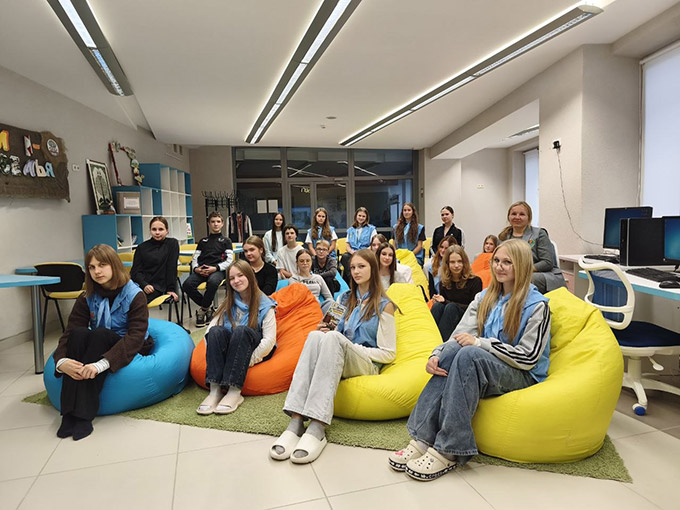 |
| 1. Students from the «Zubrenok» National Children’s Center |
 |
| 2. During the online meeting |
 |
| 3. Speakers A.V.Krent and T.V.Shilko |
 |
| 4. During the online meeting |